Posts

Despite worries surrounding Brexit, tighter margins and labour supply to name a few, optimism across Britain’s construction sector is relatively high in regards to potential growth and future profits, according to the 2017 Construction Sentiment Survey.

Causeway Technologies and Barbour ABI’s survey of the construction sector – measuring various levels of optimism, growth & obstacles within the industry, found that of those surveyed 71 per cent believe that their company’s revenue is expected to grow in 2017 compared to last year and 63 per cent foresee a growth in profits.

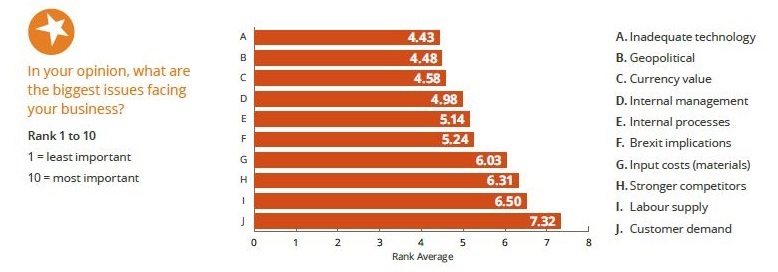
The survey also found that the three biggest issues facing the construction industry are stronger competitors, labour supply and customer demand.
Construction

A large proportion of construction companies (67 per cent) are already implementing cost-reduction measures, however they are more prevalent in larger companies (82 per cent) compared to smaller companies (58 per cent). However, the survey also showed evidence of initiatives for growth, with almost 70 per cent believing that their company is implementing initiatives to fuel growth in 2017.

Colin Smith, Chief Executive Officer at Causeway Technologies commented “The UK construction industry is facing considerable change in the coming years and needs to be well prepared for what lies ahead.”

“Whilst it is clear from the survey that construction professionals remain reasonably optimistic about 2017 with the industry growing steadily since 2013, they are also aware that they face an array of challenges, with a significant number of companies already looking at how they can cut costs and improve efficiency.”

“Identifying the issues is clearly the first step in tackling them, the next stage is for construction companies to introduce the solutions that will help them perform better in the face of the challenges they expect to encounter in 2017.”

Commenting on the figures, Michael Dall, Lead Economist at Barbour ABI, said “Construction firms are looking to “future proof” and expand markets to meet the economic challenges that inevitably lie ahead.”

“The industry appears to be learning its lessons from the years of subdued performance between 2009 and 2012 with many considering closely its initiatives for growth, issues facing their businesses but also ensuring the systems are in place to ensure they can weather any future downturn.”

The first modular homes to be built by housing association Midland Heart have landed in Coventry.

The four, three-bedroom properties on ‘Modular Mews’ in Foleshill are part of a pilot scheme delivered in partnership with developers Central Site and Coventry City Council.

Work on the scheme started toward the end of 2016 and during one weekend in February all four homes were craned in after being built off-site at a factory in Nuneaton. Construction of the development was completed within six weeks.

Midland Heart’s Director for Development, Chris Miller said “It’s been an incredibly interesting journey as we prepared the site and watched all four homes being built in just a couple of days.

“Modular homes are just one of the options we are exploring to deal with the effects of the housing crisis and are part of our commitment to build 2000 new homes across the Midlands over the next five years.”

The properties have been built to an incredibly high standard of both design and environmental sustainability making them cost-effective to run and maintain.

Each property includes amongst other amenities an externally fitted electric car charging port and walls that can be removed so properties can be easily adapted.

Brian Maunder at Central Site said “It was a pleasure to work with Midland Heart on delivering the first modular homes in Coventry, the first of many.”

The house building industry has set out a blueprint for how it believes the next Government can build on recent increases in supply and go even further to deliver more new homes in the next parliament.

Whilst supply has increased by over 50% in the past three years, if the industry is to deliver the increases all parties now agree are required, the next Government will need to continue to develop the policy agenda to allow existing builders to expand output even further and faster, and also support new entrants and struggling smaller firms. HBF’s proposals include:

  • Promoting policies that enable more builders to build – in particular SMEs – such that they can play their part in increasing output further
  • Providing certainty about the future of the Help to Buy scheme which has been absolutely key in the increases in supply to date
  • Delivering further improvements to the planning system. The time consuming and bureaucratic nature of system remains a constraint on increasing supply. Delays and costs deter new entrants and prevent construction work starting
  • Developing policies that encourage more specialist homes to be built to meet the needs of our ageing population
  • Encouraging better collaboration between infrastructure planners and house building. Builders pay millions each year towards improved infrastructure and more effective coordination would deliver considerable benefits for communities while accelerating delivery.

‘Blueprint 2017: A plan to deliver even more new homes’ sets out in detail what the new Government needs to do in each of these areas to increase supply to the level the country needs.

Stewart Baseley, executive chairman of the Home Builders Federation said “Housing supply has increased significantly over the past three years, but if we are to raise our sights still further and better match supply to demand, Government needs to play its part.

“House builders already have a strong desire to continuing boosting supply, as evidenced by the huge investments being made by the country’s largest builders in the land and workforce needed to deliver additional homes. Ensuring a policy environment that promotes development will allow this investment to be sustained.

“Over decades building homes has become increasingly costly and risky as developers have been bogged down in red tape and inevitable delays. That has driven out small firms and prevented new entrants from contributing. Encouraging greater entrepreneurialism in the sector could help boost housing supply by tens of thousands a year.

“The social implications of our housing shortage are becoming ever more apparent with today’s young people struggling to own a home, high rental payments preventing them from saving for a mortgage deposit and ever more people in sub-standard or temporary accommodation and on local authority waiting lists. Building homes helps address social issues, whilst creating jobs both directly and in the supply chain and delivering investment in existing communities.

“Delivering more desperately needed high quality homes will both help strengthen our society and give our economy a boost in the uncertain years ahead.”

In order to improve policy making and provide a better understanding of the construction industry’s contribution to society, the Chartered Institute of Building (CIOB) has outlined five interlinked policy proposals for prospective parliamentary candidates and the next Government to consider ahead of the General Election.

Chris Blythe OBE, Chief Executive of the CIOB said “The quality of our built environment affects every member of society. Construction creates and maintains the places that people live, work and play, the infrastructure that supports them and the services that sustain them. And it is vital that those elected to represent their constituents in Parliament understand this.

“Our manifesto showcases how construction can act as a solution to major policy issues. Our proposals are interlinked, showcasing the need for a collaborative approach to productivity, skills, quality, investment and Brexit.

“It is crucial that policy makers appreciate the contribution of the construction sector: the decisions made today will be felt for decades and generations.”

The five aims outlined in the CIOB’s Building the Case for Construction manifesto are as follows:

  1. Continue support for the Industrial Strategy and recognise construction’s role in improving productivity
  2. Work alongside the construction industry to support a robust system for training and skills development
  3. Recognise and address both the opportunities and risks that Brexit will bring
  4. Ensure quality is at the heart of the nation’s construction programme
  5. Focus on regional investment in construction to rebalance the UK economy

The CIOB will be communicating with prospective parliamentary candidates, urging them to consider the importance of the built environment both at a local and national level. The CIOB has also published a series of articles under the ‘Building the Case for Construction’ banner. It contains a number of resources including the manifesto, an overview of the timetables for the 2017 election and a series of questions for CIOB members and non-members to ask prospective parliamentary candidates.

The full manifesto can be accessed here.

In their election manifesto, the Conservative Party has pledged to 500,000 extra homes by 2022, as well as reaffirming their previous 2015 commitment to deliver a million homes by the end of 2020. As part of this, Theresa May must put SME house builders at the heart of her ambitious plans for housing, according to the Federation of Master Builders (FMB).

In response to last week’s release of the Conservative Party’s manifesto, Sarah McMonagle, Director of External Affairs at the FMB, said “The importance of addressing the country’s chronic shortage of homes is as great as ever, and the Conservative Party’s manifesto seems to appreciate the scale of the challenge ahead of us. A revised house building target of 1.5 million homes from 2015 to 2022 ups the ante on housing delivery again, but these ambitions can only be delivered with an accompanying focus on creating a more diverse and innovative house building sector. The decline in the number and output of smaller local house builders over the past few decades has led to the industry’s capacity haemorrhaging. To deliver the PM’s vision we will need to reverse this. The Manifesto’s explicit pledge to diversify the delivery of new homes is therefore extremely welcome. Key to doing this will be being able to build on some of the sensible reforms outlined in the recent Housing White Paper, which we hope to see implemented.”

“The Conservative Party’s manifesto sets out an ambition not only to build more, but to build better. There is a welcome emphasis on balancing the pressure for increasing the delivery of new properties with the need to deliver those homes to a high standard. As is widely recognised, smaller scale house builders have a strong focus on quality. By supporting greater diversity in terms of the companies building our new homes, a Conservative Government would be killing two birds with one stone. This is a vision that SMEs can build on.”

One of London’s most prominent brutalist residential blocks, Trellick Tower, is set for a major £7.2m restoration programme with the appointment of leading social housing maintenance provider, Wates Living Space, to deliver extensive external works.

Carried out on behalf of Kensington & Chelsea Tenant Management Organisation (KCTMO), the work marks a major investment in the preservation of the historic tower in Kensal New Town.

Following extensive planning and liaison, work on the programme is scheduled to commence immediately and will include the repair, renovation and replacement of the Grade II* listed building’s concrete, cladding and approximately 1,000 windows.

Trellick Tower was designed by Hungarian Modernist architect, Ernö Goldfinger, and was built in 1972 as part of the Brutalist architecture movement that arose from the 1950s to the mid 1970s. The tower became the inspiration for JG Ballard’s novel ‘High Rise’, which was made into a film starring Tom Hiddlestone in 2015.

Wates will first commence work on the six-storey Block B, which will be followed by the external refurbishment of the 31-storey Block A in June this year. Overall completion is expected by summer 2018.

As part of the mobilisation of its team, Wates is currently making arrangements for a range of community initiatives that will be delivered throughout the programme. This will include a series of training and employment opportunities for local people as well as engagement with local social enterprises.

The project follows from a framework agreement between KCTMO and Wates, which began in 2015, for Wates to carry out internal and external works in the north of the borough.

David Morgan, Managing Director of Wates Living Space, said “It is a huge honour to be entrusted with the refurbishment of such a historically significant London tower block. This project will involve a meticulous balance of ensuring we preserve the building’s iconic status while, most importantly, delivering the vital work with minimal disruption to Trellick Tower residents. We very much look forward to continuing our work with KCTMO and to getting under the skin of what is a landmark piece of post-war architecture.”

Robert Black, KCTMO Chief Executive, added “We’re very pleased to be working with Wates on such an important project. Both ourselves and Wates are working closely with residents to ensure that they’re fully informed and we’re committed to supporting them throughout the project. This iconic building is a favourite to many and this work will help ensure it stays that way.”

In addition to its importance as a Grade II listed residential building, Trellick Tower has featured heavily in popular culture since its construction. This includes its appearance in a series of music videos throughout the past two decades.

Standing at 98m high, the building’s unique shape and structure was also the inspiration for Channel 4’s famous reinforced concrete ‘4’ that is used to link between its programming.

UK Construction Week, the UK’s largest gathering and community of construction professionals, has conducted a survey to uncover and tackle issues facing construction, housebuilding and skills in the run up to the General Election. With over 1,000 responses from a cross section of professionals working in the sector, key points from the survey include:

  • Sir Richard Branson is named as ‘the best person’ to head up new UK infrastructure projects
  • 77% believe state intervention is needed for more housing
  • 38% want Gavin Barwell to retain his position as Housing Minister
  • 54% call for more housebuilding on brownfield sites

One of the most significant results from the survey was for Sir Richard Branson, who was voted as the best person to spearhead new UK infrastructure projects, such as HS2 and Heathrow Airport, signalling a need for more entrepreneurial vision in tackling large scale projects.

On the result, Sir Richard Branson said “I’m very flattered by the survey. The only danger is that if I oversaw these key infrastructure projects then by the time I’ve finished there would only be room for one airline and one train company, both beginning with the letter V! The key thing one needs to get right is to plan these major projects with the customer’s needs in mind. Too often these are planned by engineers for engineers and fail to meet the user’s demand. This means they are underused and fail to have the major impact they should do.”

Further results show a three way split on the government’s current housing policy with a third of those polled voting both for and against current policies, and a third not convinced either way.

Over half of those surveyed (54%) called for the next elected government to be more aggressive with planning permissions on brownfield sites to enable house building. Only 11% voted to loosen Green Belt restrictions, dispelling the myth that the construction industry wants to build on protected land.

Although the industry isn’t wholly satisfied with current housing policy, Gavin Barwell was voted overwhelmingly in favour as the best man for the job of Housing Minister, with the next name suggested, Boris Johnson, only receiving a quarter of the number of nominations. Labour’s John Healey, previous Housing Minister under the Labour government, was the third suggestion.
77% of those surveyed believe the only way to reach 1 million homes by 2020 is by state intervention, and for a council house building programme to begin.

For infrastructure, there was a two way split between Vince Cable and Sir Richard Branson who were both voted as the best people to lead UK infrastructure projects, followed by Sir Alan Sugar and Sir James Dyson. A clear indication the industry feels it needs entrepreneurial visionaries to successfully take projects forward to 2021.

In terms of major projects the industry is generally positive about these going ahead with a Conservative government, with HS2 and Heathrow seen as the safest projects followed by Hinkley point, Crossrail 2, Thames Tideway and the road renewal building programme.

However, there is a real concern that major projects will stall if the Conservative government is not re-elected, with a majority of those surveyed believing all projects will stall with HS2 coming out on top (44%) followed by Crossrail 2 (40%) followed by the road renewal building programme (40%), Hinkley Point (30%), Thames Tideway (30%) and Heathrow third runway (26%).

Nathan Garnett, Event Director at Media 10, which runs UKCW, said: “We have seen a great deal of talk around housing and infrastructure in this general election campaign so far, so I think that the main political parties should take note of this industry wide survey. It shows that there are still a lot more assurances and interventions needed to build the homes we need and the infrastructure we have been promised. We will be using these results to make sure the main political parties know what the industry wants, and one clear message is that innovation and entrepreneurial endeavour cannot happen without government assistance.”

Plaid Cymru’s proposal to cut VAT on home renovations would spark a renaissance in the Welsh construction sector, the Federation of Master Builders (FMB) Cymru has said in response to the Party’s announcement.

Ifan Glyn, Director of FMB Cymru, said “We welcome the announcement that Plaid Cymru would press the UK Government to reduce the amount of VAT currently charged on domestic refurbishment work. The economic benefits of a VAT cut would be significant and timely, given the uncertainty facing the country as it starts the process of departing the EU. Research has demonstrated that cutting VAT on such work would provide an annual £50 million stimulus to the Welsh economy, revitalising a sector that has suffered decidedly mixed fortunes over the last decade. Far from depriving the treasury of revenue, experience from the Isle of Man suggests that the reduction could actually increase net revenues by boosting demand and cutting out the black market.”

“Moreover, it would provide a necessary shot in the arm in the effort to improve the energy efficiency of Welsh homes and help reduce our carbon emissions. Our housing stock is amongst the oldest in Europe, which is a major factor behind the generally poor levels of energy efficiency in our homes. A reduction in VAT would incentivise property owners into investing to improve the energy efficiency of their homes, thereby cutting energy bills. This could play a significant role in tackling fuel poverty, which remains a serious issue for Wales.”

“A tax stimulus could also yield further dividends in the form of empty homes being brought back into the market. There are currently 25,000 properties that are unoccupied in Wales and which could be fully inhabitable again if the incentive to renovate those homes existed. This would be equivalent to nearly two years’ worth of the supply of new homes that it is agreed Wales needs to tackle our housing crisis. Obviously, Plaid Cymru are in no position to win the General Election, but this policy highlights that a VAT reduction on home renovations is both feasible and highly desirable for the Welsh economy.”

Many existing, new and retrofitted buildings exhibit large gaps between design aspirations and in use performance. To meet policy objectives and meet the needs of building owners and occupants, in-use performance needs to improve rapidly and radically. Ambitious new start-up organisation, The Building Performance Network (BPN) hopes to influence change in policy, procurement and practice, both politically and technically across the UK and global Construction markets.

Whilst many people are now aware of performance gaps for energy use and CO2 emissions, fewer people are aware that issues are also evident in technical performance, occupant satisfaction, operating costs, environmental impact and importantly the health of the occupants.

Data is the key to understanding whether we are making the right choices throughout the lifecycle of the building. The UK suffers from a disjointed building performance evaluation sector, where data are inaccessible, study methods are not clear or shared, and decisions are often made on poor or limited data.

The Building Performance Network (BPN) will be an independent not for profit organisation, operating in all building related sectors. It will work to bring together individuals and organisations with an interest in improving building performance in operation. It is founded on the principles of integrity and robustness to ensure that it remains credible and authoritative. It is open to all, not just the existing Building Performance Evaluation industry.

The BPN has the following key objectives:

  • Bring people together with an interest in building performance
  • Understand how building performance data is collected and analysed to ensure members have reliable data on which to base their decisions
  • Move forward the practice of building performance evaluation to make it accurate and useable for the sector
  • Share and make members aware of a wide range of studies undertaken in the UK, creating a data-sharing platform to move the building performance agenda forward
  • Use data to influence change in policy, procurement and practice

The BPN is founded on the principle that participation should be open for all and that the member organisation has an interest in the performance of buildings in-use. It is constituted as an independent, non-profit organisation, which requires some core funding.

Members will be a part of an exclusive collective group of expert organisations shaping the building performance landscape and be seen as a credible collaborator by Government and other organisations with an interest in this field. If you want to support engagement with government in a unified industry approach, have a say in what is proposed as industry standards and enjoy a host of annual benefits then click here to find out how you can become part of this ambitious and fast growing organisation: http://building-performance.network/

Download the prospectus here.

Construction and infrastructure workload expectations continue to improve with respondents the most positive since the referendum, according to the latest Royal Institution of Chartered Surveyors (RICS) Construction and Infrastructure Market Survey, Q1 2017. The pace of growth has increased across all sectors pointing to a widespread improvement in the sector.

In Q1 2017 27% more respondents reported an increase in workloads, (up from +18% in Q4 2016). Expectations for the next 12 months also remain firmly positive particularly for activity levels although they have reduced slightly in case of profit margins.

The shortage of skilled labour persists in UK infrastructure and construction and is again widely cited by contributors as a factor potentially impacting the performance of businesses working in the industry.

Looking at the different sectors, 34% more respondents cited an increase in private housing output rather than a decrease, which puts it above the other sectors for the pace of growth once again; this has been the case since Q1 2013.

While the commercial sector saw the largest growth in workload for the quarter (compared with Q4 2016) with 31% more respondents seeing a rise, infrastructure workloads continue to grow steadily with the most significant increases in rail, road and energy categories.

These sectors are also viewed as the most promising sectors in infrastructure for the next 12 months. Breaking this down, 60% of respondents felt that repair and maintenance work of existing structures is the most needed type of investment in their area whilst 40% felt investment in new projects was necessary.

Growing skills shortages

As workloads increase, skill shortages are still sighted as a significant problem to the industry with 53% of respondents stating a shortage of skilled labour to be a key impediment to growth.

This is slightly up from 50% in the last quarter. In recent reports, the proportion of respondents noting skill shortages to be the major barrier to growth had come down slightly but the latest results along with surveyors’ comments suggest labour shortage pressure across the UK construction sector is intensifying once more.

Alongside this, 65% of respondents reported insufficient availability of quantity surveyors, with skill shortages in this area becoming increasingly prominent since 2012. The results also point to the quality of available workers (rather than simply the quantity) being the principle driver in skill shortages, with 67% of respondents taking this view.

Looking at this further, 59% of contributors feel that improved education pathways and training would the most effective policy response to alleviate labour supply pressures, whilst 31% of contributors feel direct government subsidisation of training would be the most effective.

Financial constraints and their impact

Meanwhile, financial constraints are still the most significant obstacle to growth with 70% of respondents citing this as an issue. Planning and regulation remains a significant impediment to growth with 61% of respondents citing this as an obstacle (up from 53% in Q4 2016).

At the same time, tender prices are expected rise in the next 12 months. Specifically, 69% more respondents believe tender prices will go up in the building sector (rather than fall). The expected increase in tender prices may signal rising costs and shrinking profit margins which is also reflected in the 12 month expectation of profit margins easing from +26% in Q4 2016 to +18% in Q1 2017.

Regionally all parts of the UK have observed an increase in pace of output growth in Q1, with the exception of Northern Ireland. The was due to the pace of growth slowing within the infrastructure, private industrials and public non-housing sectors. Output growth gathered the most pace in London and the South East where the net balance rose from +7% to +22%.

Jeff Matsu, RICS Senior Economist said “The mood music in the construction sector has improved in line with the better tone to macro data more generally. However the survey does highlight some key challenges that need to be addressed if government’s ambitious plans for housing and infrastructure, in particular, are to be met. Access to finance, alongside planning and skill shortages, both quality and quantity, remain big obstacles to delivery and though some plans are in place to address these issues, it remains to be seen whether they are sufficient to make a meaningful impact.”