Building News is an information portal for all professional building specifiers. Here you can find all of the latest construction news from around the UK and the rest of the world.
Eurocell has launched two essential CPD courses designed to help fenestration and construction professionals stay ahead of evolving building regulations and overcome common compliance conflicts.
The UK’s leading manufacturer, distributor, and recycler of PVC-U building products has released Compliance with Design: Part L vs Part O and Elevating Design: Fenestration Solutions for Regulatory Compliance. The courses offer architects, specifiers, fabricators and builders, practical solutions for meeting the latest requirements in energy efficiency, overheating prevention, and fenestration design.
Compliance with Design: Part L vs Part O focuses on the balance between energy efficiency and preventing overheating. It explains how professionals can meet the requirements of both Approved Documents L and O by managing heat loss, reducing energy demand, and selecting the right glazing solutions for optimal comfort.
Elevating Design: Fenestration Solutions for Regulatory Compliance offers a comprehensive guide to overcoming the challenges of energy performance, solar gain control, and safety standards. This CPD explores how to select the best materials, glazing, and window configurations to meet regulatory demands while balancing solar gain control, ventilation, and design goals.
“We’re committed to helping fenestration professionals navigate the increasingly complex world of building regulations,” said Arron Crisp, Technical Specification Manager at Eurocell.
“For example, the conflict between Approved Document L’s energy efficiency targets and the overheating concerns in Document O is a common challenge. Maximising window size for daylight can often increase solar gain, undermining the thermal performance required by Document L. It’s a delicate balance and that’s where our CPDs come in.
“We’ve designed these CPDs to tackle challenges like this head-on, providing professionals with practical, actionable solutions to meet the toughest regulatory standards. Our goal is to help the industry create high-performance, energy-efficient designs that don’t compromise on comfort or sustainability.”
Eurocell’s courses can be taken online, in-person or on demand and provide forward thinking solutions for some of the industry’s most common challenges with building regulations.
https://buildingspecifier.com/wp-content/uploads/2025/11/EUROCELL-SUG-2.png320800Lynhttps://buildingspecifier.com/wp-content/uploads/2019/06/building-specifier-logo.pngLyn2025-11-26 15:55:512025-11-26 15:55:51NEW EUROCELL CPD HELPS YOU SOLVE PART L VS PART O CONFLICTS
PfP Thrive launches a nationwide Skills Relay to champion apprenticeships and upskilling
Opportunities for newcomers, trainees, and experienced professionals seeking development
Housing association Amplius is the first to ‘take the baton’
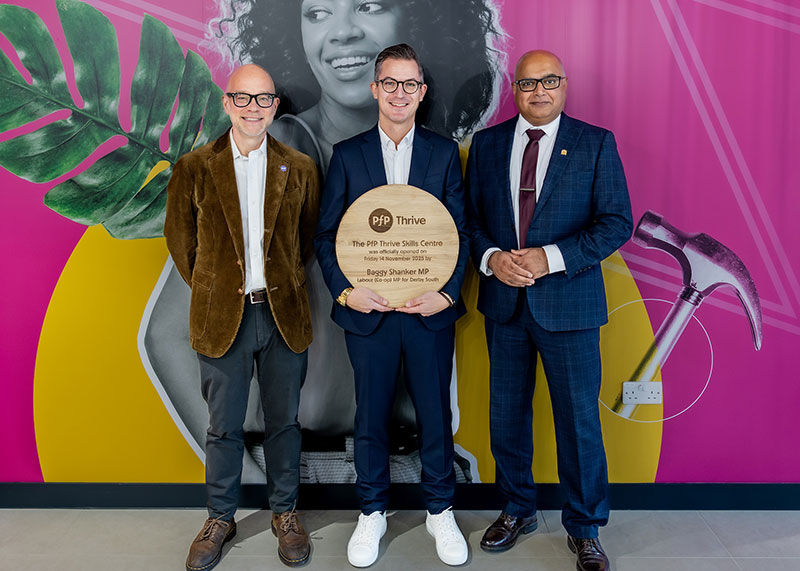
Derby MP, Baggy Shanker joins the launch to show his support
PfP Thrive, part of the UK’s leading social enterprise Places for People (PfP), has launched the Skills Relay – a nationwide challenge to tackle the UK’s construction and housing skills crisis.
With demand for qualified workers at an all-time high and a shortfall of 250,000 needed to deliver the Government’s housing and construction plans, the Skills Relay celebrates anyone with a passion for learning. It supports apprentices, trainees, and professionals looking to upskill while inspiring the next generation of skilled workers to address the sector’s growing talent gap.
A bright pink baton stars as the symbol of the challenge. It was officially unveiled at the official opening of PfP Thrive’s Skills Centre in Derby today, and will now travel across the country, visiting construction sites, colleges, and skill centres. Each handover will connect learners, employers, and training providers, making the skills challenge visible across the industry.
Tom Arey, Director at PfP Thrive, explained:
“The UK’s skills shortage is a crisis for construction and housing so that’s why we have launched the Skills Relay as a call to action for every organisation to step up. That includes our industry peers, the supply chain, education providers and the government, as we invite more collaboration to combat the biggest threat to our sector.
“This baton represents knowledge, progress, and opportunity. Every apprentice and learner who takes part is helping close the skills gap and secure the future of our sector.”
The initiative launches with Amplius as the first recipient of the Skills Relay baton in Derby today. Zoe Ferris is Head of Organisational Development and Engagement at Amplius, which owns and manages almost 39,500 homes, and said: “Collaboration is key to tackling the skills crisis. We are proud to take another step forward in our partnership with PfP Thrive and commit to giving more people the chance to learn, upskill, and progress their careers.”
Officially opening the building and launching the Skills Relay, MP for Derby South, Baggy Shanker, commented:
“It’s a real privilege to open PfP Thrive’s Derby Skills Hub. The skills gap is one of the biggest challenges facing our economy, and this government is determined to work alongside industry to fix it. What’s happening here in Derby shows exactly how that can be done – employers, educators and local people joining together to equip the next generation with skills, grow talent and build a stronger future for our city and our country.”
L-R Greg Reed, CEO Placesfor People Tom Arey, PfP Thrive Baggy Shanker, MP for Derby South
PfP Thrive provides high-quality, accredited training programmes to nurture new talent and upskill existing professionals. The Skills Relay represents a collective industry effort to pass on skills, share knowledge, and engage young people at a time when apprenticeship entries are falling – down 4% for 16-year-olds, 2% for 17-year-olds, and 1% for 18-year-olds last year.
The Skills Relay offers a tangible way for the sector to unite, build capability, and inspire a new generation of construction and housing professionals.
https://buildingspecifier.com/wp-content/uploads/2025/11/PFP-2011.25.jpg320800Lynhttps://buildingspecifier.com/wp-content/uploads/2019/06/building-specifier-logo.pngLyn2025-11-19 12:55:092025-11-19 12:55:11PfP Thrive Launches Skills Relay to Inspire the Next Generation of Construction and Housing Talent
THE Alliance for Sustainable Building Products (ASBP) and BE-ST have announced a new partnership aimed at advancing the use of low-carbon and natural products within the built environment and construction sectors.
The partnership aims to focus on areas where combining the expertise and network from each partner can make a tangible impact. These include collaborating on advocating for use of sustainable materials in both retrofit and new build applications; supporting the growth of timber-rich construction in the UK and encouraging greater adoption of homegrown timber products; and undertaking research into sustainable building solutions.
Both organisations will seek to expand the market for proven low-carbon products, such as those championed by the ASBP Natural Fibre Insulation Group.
ASBP and BE-ST will jointly explore programme development, knowledge sharing, and collaborative opportunities with industry, government, and research stakeholders.
Richard Broad, director at ASBP, said,
“We are delighted to form this strategic partnership with BE-ST to accelerate the transition to a more sustainable built environment. By aligning our networks, knowledge and expertise on timber, natural materials and more, we can strengthen the case for sustainable products and approaches and support the sector to embed low-carbon solutions at scale.”
Louise Rogers, impact manager at BE-ST, added,
“By working in partnership with ASBP, we are able to expand our impact, strengthen collaboration across the sector and ensure that sustainable construction products and solutions are embedded in both practice and policy. We hope to bring our expertise in MMC, timber engineering, and skills delivery together with ASBP to help shape policies, skills and markets that make low-carbon construction the industry standard.”
Rinnai’s CPD, ‘Seasonal Performance Factors and Heat Pump Design’, details the evaluation of SPF when measuring a heat pump system’s overall energy efficiency throughout an entire heating season, whilst further considering variations in temperature and other system factors.
Rinnai’s Seasonal Performance Factors and Heat Pump Design CPD details the potential limitations of manufacturer-issued efficiency measures for Heat pumps, namely COP (Coefficient of Performance) and SCOP (Seasonal Coefficient of Performance). Manufacturers often measure heat pump efficiency using Coefficient of Performance (COP), which is the ratio of useful heat energy produced to the electricity consumed at a specific external air temperature.
A SCOP efficiency rating solely measures the heat pump unit which may yield a lack of system congruity when considering the entire system. Consequently, relying on this performance measurement alone can affect customer expectations in system performance and carbon reductions.
Rinnai offer an alternative methodology in measuring system efficiency; a Seasonal Performance Factor approach evaluates all energy utilizing components within a commercial hot water system and measures the performance of the entire system, as opposed to solely the heat pump.
By presenting this CPD to UK customers, contractors, consultants, specifiers and installers, Rinnai aims to provide information that delivers a concise and true account of commercial hot water heating performance using the ‘Seasonal Performance Factor’ methodology.
Rinnai UK’s new division – Rinnai Applied has multiple bursaries available and to qualify you must be fully eligible and successfully complete the three CPD sessions between now and March 2026.
The CPDs are on the following subjects:
Seasonal Performance Factors (SPF) and Heat Pump Design
Introduction to Water Neutrality
Retrofitting Heat Pumps into the Leisure Sector through CCA & SPF Analysis
Rinnai continues to inform the UK market of system operating details that provide an accurate statement of performance, while considering the effects on operational expenditure, economic investment, and environmental impact.
RINNAI OFFERS CLEAR PATHWAYS TO LOWER CARBON AND DECARBONISATION
PLUS CUSTOMER COST REDUCTIONS FOR COMMERCIAL, DOMESTIC
Rinnai’s range of decarbonising products – H1/H2/H3 – consists of hot water heating units in gas/BioLPG/DME, hydrogen ready units, electric instantaneous hot water heaters, electric storage cylinders and buffer vessels, a comprehensive range of heat pumps, solar, hydrogen-ready or natural gas in any configuration of hybrid formats for either residential or commercial applications. Rinnai’s H1/2/3 range of products and systems offer contractors, consultants, and end users a range of efficient, robust, and affordable low carbon/decarbonising appliances which create practical, economic, and technically feasible solutions.
Rinnai is a world leading manufacturer of hot water heaters and produces over two million units a year, operating on each of the five continents. The brand has gained an established reputation for producing products that offer high performance, cost efficiency and extended working lives.
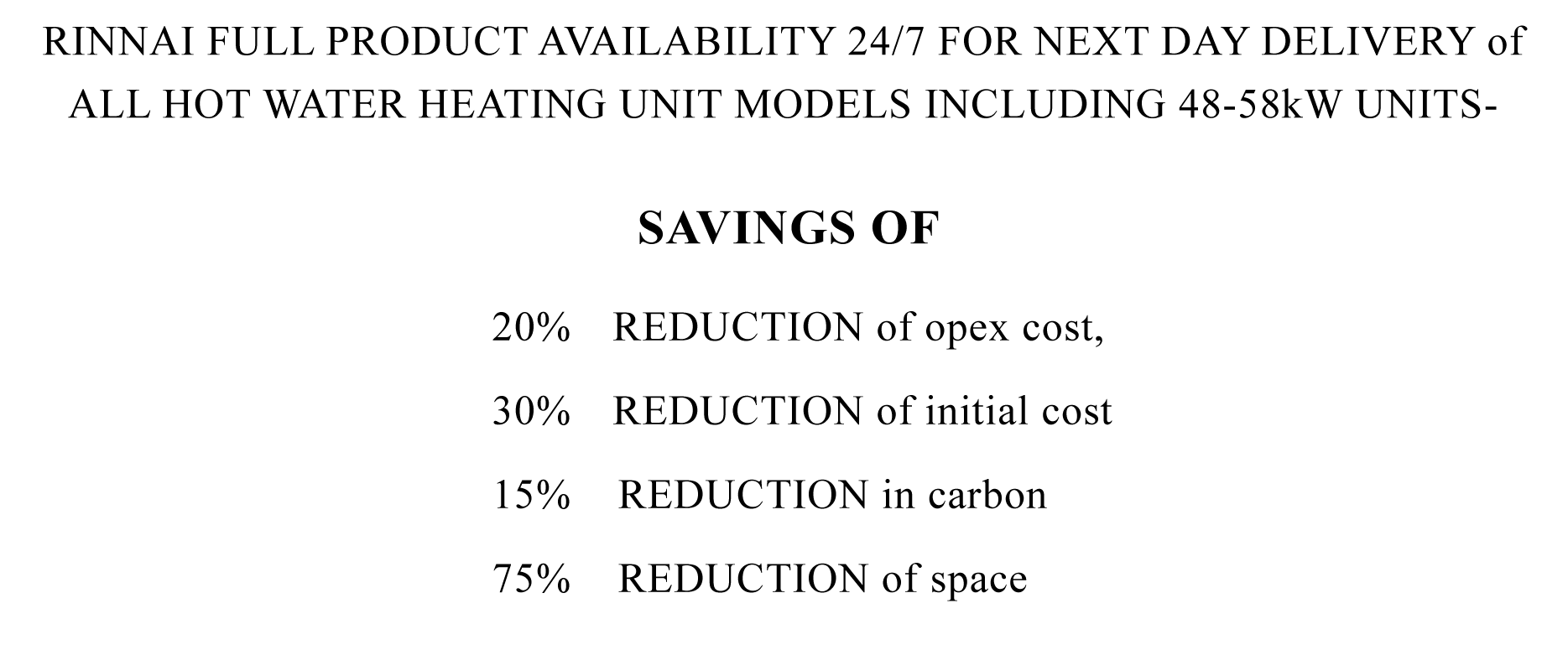
Rinnai products are UKCA certified, A-rated water efficiency, accessed through multiple fuel options and are available for purchase 24/7, 365 days a year. Any unit can be delivered to any UK site within 24 hours.
Rinnai offer carbon and cost comparison services that will calculate financial, and carbon savings made when investing in a Rinnai system. Rinnai also provide a system design service that will suggest an appropriate system for the property in question.
Rinnai offer comprehensive training courses and technical support in all aspects of the water heating industry including detailed CPD’s.
The Rinnai range covers all forms of fuels and appliances currently available – electric, gas, hydrogen, BioLPG, DME solar thermal, low GWP heat pumps and electric water heaters More information can be found on Rinnai’s website and its “Help Me Choose” webpage.
https://buildingspecifier.com/wp-content/uploads/2025/11/rinnai-na-19.11.25.jpg320800Lynhttps://buildingspecifier.com/wp-content/uploads/2019/06/building-specifier-logo.pngLyn2025-11-18 11:52:442025-11-18 11:52:44Understand SPF for Smarter Heat Pump System Design with Rinnai CPD
Free Access for Industry Professionals – and Learn & Earn Bursaries
Rinnai’s recent additions to the company’s extensive list of industry relevant CPDs include SPF – Seasonal Performance Factors and Heat Pump Design; Introduction to Water Neutrality and Retrofitting Heat Pumps into the Leisure Sector through CCA & SPF Analysis.
Sign up today as places are limited at and see how you can earn and learn bursaries of up to £200 on successful completion of all three CPDs.
All the CPDs provide updated insights into significant issues concerning contractors, consultants, specifiers, system designers, and installers operating in the UK HVAC market.
A CPD on Seasonal Performance Factor (SPF) discusses the measure of a heat pump system’s overall energy efficiency over an entire heating season, considering variations in temperature and other system factors. This CPD helps with assessing the real-life performance of a heat pump system when in use.
A CPD on Water Neutrality details a subject that will become increasingly important as UK water supplies become less accessible due to overpopulation and climate change. Rinnai aims to increase awareness of this issue as well as supply industry insight into the question: should water neutrality be added to national legislation?
A CPD on Heat Pumps Retrofit evaluates all aspects of this increasingly important subject. Heat Pumps can be readily fitted to existing or even older properties in both residential and commercial sectors. This CPD analyses the specific needs of retrofitting in terms of design, appliance installation as well as meeting the required heating and hot water demand. Further attention is applied to how the concept of retrofitting demands further attention in relation to maximising energy efficiency.
All Rinnai CPDs are CIBSE accredited. Rinnai Applied supports a transparent and educational approach to information sharing that provides specifiers, system designers, contractors, installers, and customers with nutritional knowledge that adds understanding and clarity towards evolving ideas inside the UK HVAC industry.
Rinnai UK’s new division – Rinnai Applied – is also offering an opportunity to gain bursaries of £200 when those eligible successfully complete these three specific CPDs.
Rinnai continues to inform the UK market of system operating details that provide an accurate statement of system performance, while considering the effects on operational expenditure, economic investment, and environmental impact.
Sign up today as places are limited
RINNAI OFFERS CLEAR PATHWAYS TO LOWER CARBON AND DECARBONISATION
PLUS CUSTOMER COST REDUCTIONS FOR COMMERCIAL, DOMESTIC
Rinnai’s range of decarbonising products – H1/H2/H3 – consists of hot water heating units in gas/BioLPG/DME, hydrogen ready units, electric instantaneous hot water heaters, electric storage cylinders and buffer vessels, a comprehensive range of heat pumps, solar, hydrogen-ready or natural gas in any configuration of hybrid formats for either residential or commercial applications. Rinnai’s H1/2/3 range of products and systems offer contractors, consultants, and end users a range of efficient, robust, and affordable low carbon/decarbonising appliances which create practical, economic, and technically feasible solutions.
Rinnai is a world leading manufacturer of hot water heaters and produces over two million units a year, operating on each of the five continents. The brand has gained an established reputation for producing products that offer high performance, cost efficiency and extended working lives.
Rinnai products are UKCA certified, A-rated water efficiency, accessed through multiple fuel options and are available for purchase 24/7, 365 days a year. Any unit can be delivered to any UK site within 24 hours.
Rinnai offer carbon and cost comparison services that will calculate financial, and carbon savings made when investing in a Rinnai system. Rinnai also provide a system design service that will suggest an appropriate system for the property in question.
Rinnai offer comprehensive training courses and technical support in all aspects of the water heating industry including detailed CPD’s.
The Rinnai range covers all forms of fuels and appliances currently available – electric, gas, hydrogen, BioLPG, DME solar thermal, low GWP heat pumps and electric water heaters More information can be found on Rinnai’s website and its “Help Me Choose” webpage.
ACV UK Expands CIBSE-Approved CPD Portfolio with New Module on Commercial DHW Systems
ACV UK, a leading specialist in hot water and heating solutions, has expanded its CIBSE-approved CPD portfolio with the launch of a new module: “What You Need to Know – Commercial DHW Systems Now and for the Future”. Designed for building services professionals, the new CPD helps consultants, specifiers and contractors navigate the fast-moving landscape of domestic hot water (DHW) system design in commercial buildings.
With the need to comply with updated regulations and improve system efficiency, the new CPD from ACV UK explores how market demands are shifting and what that means for modern DHW system specification. It also covers key drivers such as changes to Part L, the expanding range of available technologies and how to approach system design in a way that balances carbon reduction, reliability and cost. Participants will also gain insights into demand profiling, system sizing, hybrid strategies and practical considerations such as site constraints and long-term operational performance.
Designed for professionals involved in new build projects, plant room upgrades, or refurbishment work, the session provides a clear, practical overview of both the challenges and opportunities shaping the future of commercial DHW. To suit busy working schedules, the CPD lasts 45–60 minutes and can be delivered in person, online, or at ACV’s Expert Academy Training Centres.
The new module complements ACV UK’s existing portfolio of CIBSE-approved CPDs. These include “Factors Driving Material Selection for Hot Water Storage Products” which highlights the durability and performance of stainless steel in commercial DHW systems, and “Decarbonisation Using Electric Boiler Technology in Non-Domestic Properties,” which examines how electric boilers can support carbon reduction goals, particularly in hybrid systems or installations where heat pumps are not feasible.
As the industry continues to adapt to the net zero agenda and increasingly complex regulatory requirements, ACV’s CIBSE-approved CPD programme equips professionals with the knowledge needed to deliver quality, future-proof solutions.
https://buildingspecifier.com/wp-content/uploads/2025/10/AVC-30.10.25.jpg320800Lynhttps://buildingspecifier.com/wp-content/uploads/2019/06/building-specifier-logo.pngLyn2025-10-29 12:17:022025-10-29 12:17:02New Module on Commercial DHW Systems from AVC UK
Groundforce Shorco has supplied a variety of specialised props and beams to support a complex deep excavation in the centre of London.
Specialist contractor Ground Construction Ltd was employed by main contractor Ardmore to carry out extensive basement works for a new life science campus in the King’s Cross Knowledge Quarter.
Designed by architects Bennett Associates for developer the Reef Group, the Tribeca development will ultimately provide a million square feet of life sciences, office, retail, leisure and residential space.
Phase One was completed in July 2024 and Ardmore’s £240m contract for Phase Two – comprising three multi-storey buildings totalling 540,000 sq ft – is due for completion in 2026.
Ground Construction Ltd used Groundforce temporary propping equipment to support the main basement excavation for Blocks C2 and C3 as well as multiple smaller excavations within the main excavation area.
Due to the complexity of excavation, a variety of propping equipment was required, ranging from light-duty MP30 mechanical struts to the MP375, one of the largest in the Groundforce Shorco range of modular hydraulic struts, capable of supporting a load of 375 tonnes.
Groundforce Mega and Super Mega Brace waling beams were employed to transfer the lateral loads to the contiguous bore piles and steel sheet piles lining the sides of the excavations.
The excavations ranged in depth from about 8.5m in Block C2 to as much as 15m in the main excavation area, and ranged in width from about 2.5m to 44m.
A total of 28 Groundforce Shorco props have been installed on the project. Nine MP250s and the one MP375 were installed within the main excavation; four MP150s were installed to support the retaining wall in the southwest excavation; 13 MP150s, two MP30s and one MP250 support the excavation for the attenuation tank, and four MP250s were located in the core cap excavation.
Groundforce Shorco’s ability to mix-and-match components from its range of modular components was essential to providing a tailored solution to this complex task. In addition to the four different sizes of prop, they also supplied extension tubes in diameters of 508mm, 610mm, 813mm and 1,220mm (the largest in the range) to ensure the optimum combination of strength, stiffness and compactness.
The largest tubes – the 1,220mm Super Tube – were used in combination with MP250 hydraulic rams to span the 44m width of the main excavation at two levels.
The site’s location in a densely populated urban area provided an additional challenge for the site team.
“The site has roads on two sides and a canal along a third,” says Ground Construction Ltd Temporary Works Director Keith O’Connor.
Load monitoring has been used for some of the props in the main excavation along the run to ensure that loadings are closely monitored for any increases beyond the design limits.
The excavation is complicated and has been tricky, admits Keith. “But the biggest challenge has been managing the sequence of the works and the release of areas on site,” he says.
“There were a number of Interacting excavations which required careful management across the site but we worked with GCL to ensure safe, efficient and adaptable solutions. Contributing to such a landmark London development and seeing our designs perform on site has been highly rewarding,” says Hussein Koussan, Design Engineer at Groundforce Shorco.
Ground Construction Ltd and Groundforce Shorco have worked together on several previous projects and teamwork has been crucial on this site, says Keith O’Connor:
“This has been a challenging project but progress has been quite straightforward.”
The Pallet LOOP enhances offer with three-day collection service
Ten-day service replaced by faster solution to support waste and sustainability goals
Companies using The Pallet LOOP across the UK mainland will now get their pallets picked up faster, as the business introduces a free three-day collection service option.
With immediate effect, all collections booked via The Pallet LOOP’s nationwide recovery network will be completed within three working days – reflecting The Pallet LOOP’s dedication to customer service, supply chain efficiency, and environmental responsibility.
Through this groundbreaking scheme, businesses earn £2 to £4 for every LOOP pallet that is returned, ensuring they are continually reused, while also reducing construction waste.
Part of timber and forestry business BSW Group, The Pallet LOOP previously offered two collection possibilities; a three-day service (with a £100 fee); and a free ten-day option.
LOOP’s free three-day service now becomes the default, replacing the current ten-day offer. Simplifying the collection service will support the UK construction industry in several ways:
Reduced storage requirements: Shortening the LOOP collections window to three days will help pallet recipients free up valuable yard, site and warehouse space.
Enhanced sustainability: With a faster collections service, more LOOP pallets re-enter the supply chain more quickly, rather than ending up damaged or in skips.
Greater customer satisfaction: The speed of collections has been a consistent topic in customer feedback received by The Pallet LOOP, particularly from site managers in large cities, where there is limited space to store pallets.
Andy Williamson, Managing Director of The Pallet LOOP, said:
“Offering a prompt collection service is another critical step to closing the loop on pallet waste and delivering on our circular economy model.
“No one wants to see LOOP pallets laying around, taking up valuable space. By guaranteeing collection within three business days, we’re making life easier for customers and ensuring pallets get back into circulation where they belong, as quickly as possible.
“It’s an operational shift that shows us stepping up a gear, which is ultimately a win for the circular economy, building materials supply chain and the environment.”
With The Pallet LOOP’s three-day service, the collection of 50 or more pallets (green and white) is free, but collections of under 50 pallets will incur a £100 charge, while each standard white pallet returned will also cost £2.
“They’re Building Houses From Dirt Now”: Japan’s Revolutionary Discovery That Changes Construction Forever
In a groundbreaking move that could redefine sustainable construction, Japanese company Lib Work is utilizing 3D printing technology to build homes using earth instead of traditional concrete, offering a glimpse into the future of eco-friendly architecture.
In recent years, 3D printing has made significant strides in the construction industry, with innovative projects sprouting up around the globe. From rapid construction homes in Portugal to the architectural marvel of the 6,500-square-foot Wavehouse in Germany, the technology is reshaping how we think about building. Now, a Japanese company called Lib Work is pushing the boundaries of sustainability in 3D printing by using earth instead of concrete as a primary building material. Their prototype, the Lib Earth House, stands as a testament to what can be achieved when tradition and technology intersect in novel ways.
Saying Goodbye to Concrete: Embracing Earth
While Lib Work is not the first to explore 3D printing in construction, it distinguishes itself by completely eliminating concrete from its building process. Traditionally, concrete has been a staple in 3D printed structures, especially for foundations. However, Lib Work has opted for a combination of earth, lime, and natural fibers, even for the foundation. This innovative approach has resulted in a single-story home with an area of approximately 1,100 square feet. The company’s decision to forgo concrete is not merely symbolic; they have also developed technology to ensure that their unique material mix possesses adequate strength and workability for construction purposes.
Lib Earth House Model B: Key Features
The creation of the Lib Earth House involved collaboration between Lib Work Co., Arup, and Wasp, the manufacturer of the 3D printer used. The house’s standout feature is its recyclability at the end of its lifecycle. Key elements include:
Component
Description
Foundations and Walls
Earth-based mixture
Structure
Wooden frame
Rooms
Living/dining area, bathroom, kitchen, toilet
Exterior Environment
Court with natural space
Technology
Tesla Powerwall battery + solar panels
Style
Modern
The use of renewable energy sources like solar panels and Tesla’s Powerwall battery further underscores the project’s commitment to sustainability. The modern design is not just an aesthetic choice but a statement about the future of eco-friendly living.
The Future of Construction and Lib Work
3D printing in construction offers numerous advantages, including rapid execution, cost-effectiveness, and efficient material usage. This method significantly reduces environmental impact, whether using concrete or earth. For Lib Work, the ability of 3D technology to create shapes that are otherwise impossible to construct opens doors for extreme customization. This is not limited to residential homes but extends to other types of buildings as well. The company is eyeing future projects that could even involve construction on Mars, illustrating their far-reaching vision.
Challenges and Opportunities in Sustainable Construction
The shift from traditional materials like concrete to more sustainable options such as earth involves several challenges. Ensuring the structural integrity and durability of earth-based materials is a primary concern. However, as technology advances, these challenges are being met with innovative solutions. Lib Work’s approach could inspire other companies to explore similar sustainable practices. The construction industry is at a pivotal point where environmental considerations cannot be ignored. As companies like Lib Work demonstrate the potential of earth-based 3D printing, the industry could see a broader adoption of these methods.
The journey towards sustainable construction is not without its hurdles, but the opportunities for reducing environmental impact and enhancing living conditions are immense.
As we look to the future, the question remains: How will the integration of sustainable materials and advanced technologies shape the next generation of construction practices? The potential for change is significant, and the direction we choose could redefine the built environment for years to come.
https://buildingspecifier.com/wp-content/uploads/2025/09/BSC-27.09.25-5.jpg320800Lynhttps://buildingspecifier.com/wp-content/uploads/2019/06/building-specifier-logo.pngLyn2025-09-27 08:38:522025-09-27 08:38:52‘They’re Building Houses From Dirt Now’
The race to build AI infrastructure is on and speed is everything
Amid the challenges now synonymous with building AI infrastructure, stakeholders still expect data centers on demand. So, what are the best strategies for delivering next-gen facilities, fast?
The rapid evolution of AI is reshaping industries and data centers are at the epicenter of that change. AI has transformed how we design, build, and operate these facilities. It is driving demand for new infrastructure centers built to handle high-density workloads, designed with scalability at their core.
This urgency is further compounded by complex supply chain issues, including shortages of critical components, extended lead times, and rising material and transportation costs. At the same time, labor and knowledge gaps, plus mounting demand for power to support energy-hungry applications, present layers of challenges.
In this high-pressure landscape, Exyte supports operators with strategies built for speed, scale, and reliability. As a global leader in end-to-end infrastructure solutions, Exyte draws on deep technical experience, strong vendor relationships, and modular construction expertise.
Axel Favillier, director project & construction management data centers at Exyte, explains how a manufacturing mindset and early engagement are key to staying ahead of supply chain volatility and rising technical demands. Even amid uncertainty, Exyte’s strategy enables clients to move quickly, reduce risk, and compete at scale.
Getting ahead of the supply chain
Volatility in the global supply chain has become a familiar challenge, as geopolitical factors and material shortages regularly disrupt access to essential components and systems. For data centers, these disruptions are threatening project timelines and budgets.
To stay ahead, Exyte prioritizes early and proactive involvement in the procurement process. By engaging at the design stage and promptly securing orders for essential equipment, Exyte can minimize the risk of delays and enhance the resilience of project schedules.
According to Favillier, “This approach keeps projects moving and ensures teams are ready to pivot when challenges arise.” At the same time, the company incorporates mitigation strategies into its project plans, allowing teams to swiftly adapt if supply issues arise.
Early engagement supports a modular construction approach, where components are designed, fabricated, and tested off site before being delivered and installed on site. By participating early in the engineering and procurement process, teams can align design decisions with manufacturing capabilities resulting in faster assembly, improved quality control, and greater efficiency on site.
A manufacturing mindset
With a growing network of offsite prefabrication facilities, Exyte manufactures its own core modules including electrical, mechanical, and integrated systems under controlled conditions. This not only improves quality and consistency but also reduces onsite labor requirements and construction risks.
Exyte continues to invest in its in-house engineering and manufacturing capabilities to deliver high-performance, future-ready infrastructure solutions as standard. “The expectation in the near future is for an aggressive increase in the proportion of our buildings to be built off-location on satellite sites, modules built in factories and brought to location,” says Favillier.
“When we modularize, we operate with a manufacturing mindset. We are tracking timelines closely, anticipating issues thanks to lean production management, and addressing these issues before they happen to help keep timelines on track.”
Controlling the end-to-end process from procurement through installation and de-risking delivery is a pivotal advantage. This approach to supply chain management helps ensure Exyte can deliver AI-ready infrastructure at pace, transforming uncertainty into a confident commitment that clients can rely on.
Providing built-in flexibility
As AI adoption accelerates, so is the pace of change within every aspect of the data center. Today’s workloads are more power and cooling intensive than ever before, and facilities must be designed to evolve alongside demand. As such, flexibility is a mission-critical priority.
From layout to mechanical systems, built-in flexibility allows operators to adapt to changing demands without major disruptions to the infrastructure. Modular construction supports this agility by allowing large elements of the data center to be pre-assembled and delivered as complete units, ready to go as soon as they arrive on site.
One of the most pressing examples of the need for flexibility is cooling. As data centers transition from traditional air cooled systems to liquid or hybrid methods, many legacy facilities are proving difficult to retrofit. New designs must not only support today’s workloads but anticipate tomorrow’s requirements.
Exyte is addressing this by making modularity the foundation of its designs: “We are consistently looking at smart ways to modularize data centers, not just for specific components, but for the entire structure,” says Favillier.
“That way, when clients need to increase their power or cooling capacity, they can scale by simply adding another module set. This is all designed to be stacked, expanded, and upgraded like Lego blocks.”
Balancing standardization with customization is also key. By standardizing core modules and processes, Exyte creates efficiencies across quality control, assembly, safety, and installation. This reduces rework, enhances consistency, and accelerates project timelines, while allowing operators to tailor layouts and performance features to meet specific business needs.
Quality control is another core benefit of this approach. By manufacturing modules in controlled environments, inspections and quality tests can be conducted before components ever arrive on site.
Once delivered, these plug-and-play systems are connected, tested, and commissioned with minimal disruption. The result is a faster, more predictable construction timeline and a data center built to perform from day one and fit to scale up in the future.
The value of a global footprint
In a supply-constrained and highly specialized industry, global reach offers a significant strategic advantage. With operations across strategic markets, Exyte can tap into a broader network to source materials and components, manage regional cost fluctuations, and deploy expert teams on the ground wherever they are needed.
A global footprint also enables a consistent approach to project delivery, regardless of location. Exyte prioritizes standardization across engineering, construction, and project management so that each and every project reflects the company’s commitment to quality, safety, and innovation.
This consistency in approach provides a level of predictability where customers know what to expect, whether building in Asia, Europe, or North America. For companies expanding into new geographies, having a trusted partner that can replicate a successful model across borders is invaluable.
The ability to deploy local expertise on a global scale throughout each stage of a project, means the company can track progress in real-time, identify bottlenecks early, and keep projects moving forward.
From design through to delivery, this boots-on-the-ground model helps enforce global best practices for health and safety, ensuring that even in local markets, projects meet international standards, and every undertaking is delivered with safety as a top priority.
Leveraging vendor relationships
Soaring demands bring expanding supply chains. The industry is experiencing a rush of new entrants – namely vendors and service providers looking to capitalize on growth. While this has sparked innovation, it’s also made reliability and consistency harder to guarantee.
To maintain control and reduce risk, Exyte emphasizes two strategic approaches: building internal capabilities and developing strong trade partnerships. On the self-sufficiency side, the company is increasingly taking responsibility for scopes traditionally handled by subcontractors, such as having its own in-house module manufacturing capabilities allowing it to better manage project timelines, costs, and safety standards.
Equally, Exyte recognizes the value of strategic partnerships working to shift from transactional relationships to long-term collaborations and evolving from subcontractor roles to trade partner mindsets.
“We are looking to bring our partners along with us,” explains Favillier. “It’s about developing mutual trust and raising standards together, over time, especially as we grow into new regions.”
This includes blending global suppliers with local contractors. International vendors bring scale and consistency, while local partners contribute essential knowledge of building codes, labor regulations, and health and safety practices specific to the region. Together, these partnerships enable Exyte to maintain consistently high standards while adapting to local nuances.
It’s clear that, in today’s uncertain landscape, where geopolitical tensions and economic volatility can cause ripple effects across global supply chains, having a clear strategy and the right partners is essential.
AI has ushered in a new generation of complex challenges, as well as exciting opportunities. Facilities must be built faster, perform better, and possess the capacity to evolve continuously. In this environment, combining speed with foresight and flexibility is foundational to long-term success.
Exyte is helping operators meet demand and overcome primary obstacles with an approach rooted in innovation, forward-thinking, and strategic collaboration. Through modular design, global reach, early procurement, and strong partnerships, Exyte is well-equipped to deliver the AI-ready infrastructure of tomorrow, today.
https://buildingspecifier.com/wp-content/uploads/2025/09/BSC-27.09.25-2-1.jpg320800Lynhttps://buildingspecifier.com/wp-content/uploads/2019/06/building-specifier-logo.pngLyn2025-09-27 07:24:262025-09-27 07:24:26The race to build AI infrastructure
We may request cookies to be set on your device. We use cookies to let us know when you visit our websites, how you interact with us, to enrich your user experience, and to customize your relationship with our website.
Click on the different category headings to find out more. You can also change some of your preferences. Note that blocking some types of cookies may impact your experience on our websites and the services we are able to offer.
Essential Website Cookies
These cookies are strictly necessary to provide you with services available through our website and to use some of its features.
Because these cookies are strictly necessary to deliver the website, refusing them will have impact how our site functions. You always can block or delete cookies by changing your browser settings and force blocking all cookies on this website. But this will always prompt you to accept/refuse cookies when revisiting our site.
We fully respect if you want to refuse cookies but to avoid asking you again and again kindly allow us to store a cookie for that. You are free to opt out any time or opt in for other cookies to get a better experience. If you refuse cookies we will remove all set cookies in our domain.
We provide you with a list of stored cookies on your computer in our domain so you can check what we stored. Due to security reasons we are not able to show or modify cookies from other domains. You can check these in your browser security settings.
Other external services
We also use different external services like Google Webfonts, Google Maps, and external Video providers. Since these providers may collect personal data like your IP address we allow you to block them here. Please be aware that this might heavily reduce the functionality and appearance of our site. Changes will take effect once you reload the page.