



Budget Uncertainty Depresses November Figures
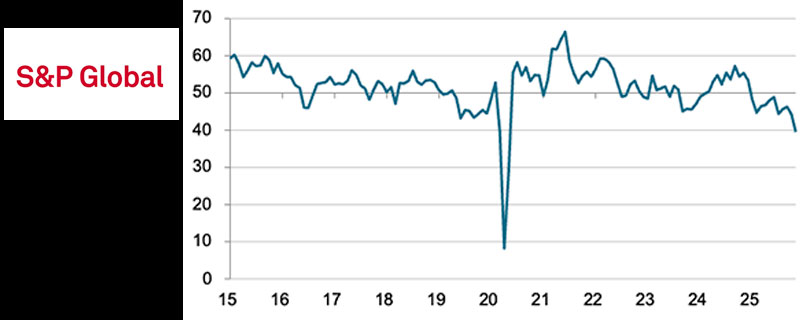
Source: S&P Global PMI
November 2025
All three construction sub-sectors saw the greatest fall in activity since May 2020
Steep reductions in new orders and employment
Business optimism weakest since December 2022
November data pointed to a sharp and accelerated reduction in output levels across the construction sector amid widespread reports of challenging market conditions.
New orders also decreased to the greatest extent since May 2020. Many construction companies commented on weak client confidence, alongside delayed spending decisions linked to uncertainty ahead of the Budget.
At 39.4 in November, down from 44.1 in October, the headline S&P Global UK Construction Purchasing Managers’ Index™ (PMI®) – a seasonally adjusted index tracking changes in total industry activity – was the lowest since May 2020. Lower volumes of construction output have now been recorded for eleven months in a row.
Sub-sector data showed that housing activity (index at 35.4), commercial construction (43.8) and civil engineering (30.0) all experienced the fastest downturns in activity for five-and-a-half years. Survey respondents commented on fragile market confidence, delays with the release of new projects and a general lack of incoming new work.
Total new business decreased at a rapid pace in November. Around 44% of the survey panel reported a fall in new orders, while only 17% signalled an increase. Aside from the pandemic, the resulting seasonally adjusted New Orders Index pointed
to the fastest downturn in new work since early-2009. Construction companies commented on sales headwinds due to risk aversion among clients, worries about the UK economic outlook and elevated business uncertainty ahead of the Budget.
Employment numbers across the construction sector decreased for the eleventh consecutive month in November, reflecting a lack of new work to replace completed projects and elevated wage pressures. The latest fall in staffing levels was the steepest since August 2020. Subcontractor usage also decreased, as has been the case in each month since December 2024.
Supplier performance meanwhile improved solidly in November and to the greatest extent since June 2024. Survey respondents noted that softer demand for construction products and materials had helped to alleviate supply chain
pressures, although some firms cited ongoing challenges with shipping delays. Latest data also indicated that overall buying activity dropped at the steepest pace for five-and-a-half years.
Cost burdens increased at an accelerated pace in November, but the speed of inflation remained well below the long-run survey average. Anecdotal evidence pointed to higher prices paid for a range of items, especially electrical components, copper products and insulation.
Looking ahead, the proportion of construction companies expecting an upturn in business activity in the next 12 months (31%) narrowly exceeded those forecasting a decline (25%).
The resulting Future Activity Index signalled the lowest degree of optimism since December 2022. Some firms commented on hopes of a rebound in general market conditions and support from lower borrowing costs. However, this was offset by
signs of cutbacks to clients’ investment spending plans and concerns about long-term domestic economic prospects.
Tim Moore, Economics Director at S&P Global Market Intelligence, said:
“November data revealed a sharp retrenchment across the UK construction sector as weak client confidence, and a shortfall of new project starts again weighed on activity.
“Total industry activity decreased to the greatest extent for five-and-a-half years, led by steep falls in
infrastructure and residential building work. Commercial construction also faced severe headwinds during November as business uncertainty in the run up to the Budget pushed clients to defer investment decisions.
“Lower workloads, alongside pressure on margins from rising wages and purchasing costs, continued to dampen staff hiring in November. The latest round of job cuts was the most marked since August 2020.”
“Construction companies also signalled a slide in business activity expectations for the year ahead as hopes of an imminent rebound in sales pipelines faded in November. The degree of optimism dropped to its
lowest since December 2022 amid reports of cutbacks to client budgets and pervasive worries about long-term UK economic growth prospects.”
COMMENTS:
Dr David Crosthwaite, BCIS chief economist, said:
If the latest construction PMI isn’t setting off alarm bells in Parliament, something’s seriously amiss.
The steepest downturn in UK construction activity in five-and-a-half years, including eleven consecutive months of decline this year, is no fluke.
It mirrors an industry battling low client confidence, stifled demand and skills bottlenecks compounded by a limited financial ability to recruit.
According to insight from the latest BCIS All-in Tender Price Index Panel, sentiment surveys are often a temperature check of construction’s SMEs where government data is more reflective of larger contractor outputs.
If that’s the case, the latest PMI suggests current government actions are not enough and still failing the near-900,000 SMEs in construction.
Increasing the cost of doing business in the Budget now feels even more like a step in the wrong direction.


Leave a Reply
Want to join the discussion?Feel free to contribute!